


The Levels of Existence in Spiral Dynamics (2/4)

Spiral Dynamics is a useful tool for shedding light on the changes underway and for understanding the stages of individual, collective, and organizational transformation in an increasingly complex world. This four-part series aims to explore this lens.
The first article, titled Introduction to the Evolutionary Model of Spiral Dynamics, lays the foundations for the levels of existence and layers of values in Spiral Dynamics. In this article, we will explore the different levels of existence in Spiral Dynamics in detail, and the third article illustrates Evolution Illustrated with Spiral Dynamics (burnout and the evolution of our post-industrial society). Finally, the last article will highlight how earlier levels of existence can be reactivated: Spiral Dynamics in the time of Coronavirus.
The different levels of existence
In his initial research, Professor Clare Graves identified eight levels of existence. Before Don Beck and Christopher Cowan named this model “Spiral Dynamics” and gave it the colors we know today, Graves represented value systems (or levels of existence) using letters. The first part of the alphabet (A to H) represented the evolution of life conditions and the second part (N to U) represented the evolution of our neuropsychological adaptive capacities. This dual evolutionary movement is what Graves initially called the emerging double-helix model of evolution. This double helix is the origin of the alternation between value systems characterized by self-expression (on the left of the diagram) and those characterized by self-sacrifice (on the right). We tend to believe that individual development and collective development are opposing movements, when in reality they alternate throughout our evolution.
Each level of existence therefore corresponds to a new “way of thinking” in response to new life conditions and a more complex environment. Each level includes positive and negative aspects. It would be wrong to categorize an individual or a personality type by levels or colors. It is better to see a level as a way of thinking in response to evolving circumstances.
Let’s remember that this is not about judging whether one level is better than another, or climbing the ladder from beige to “evolve” to turquoise through an act of will. The ego quickly sets traps for us. It is essential to see that it is not better to operate at the “green” stage than at the “orange” stage; only the congruence between our way of thinking, our behaviors, and the life conditions is adequate or inadequate. A level of existence is appropriate as long as it is adapted to our clife conditions.
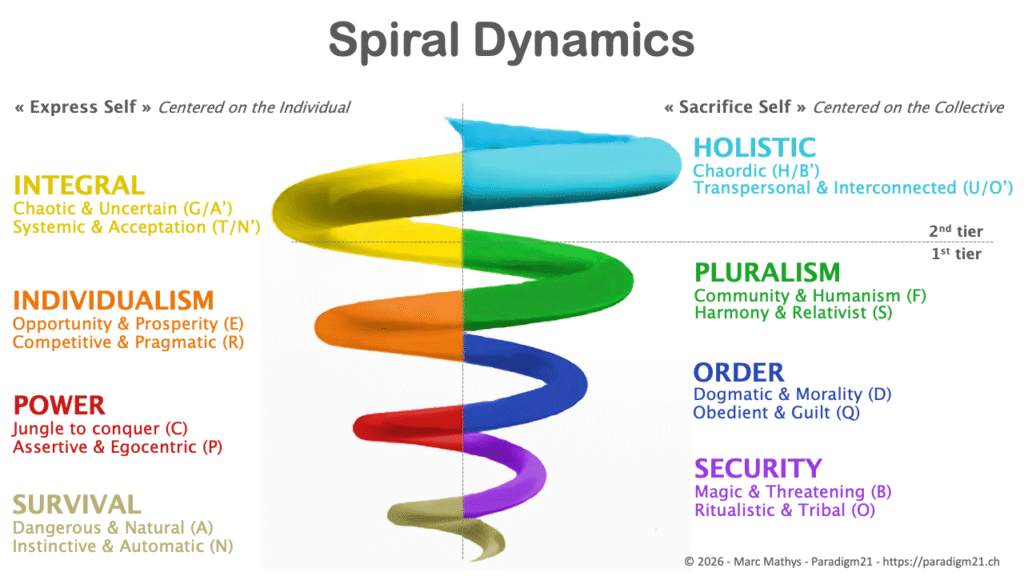
1. Survival (beige)
Keywords: instinct, reptilian brain and midbrain
Worldview: a dangerous natural environment.
Thinking: automatic; there is no conscious value system.
Actions: ensure survival by following instincts and meeting biological needs.
Description: this level of human existence is instinctive in nature and oriented toward survival. Time is only a matter of the here and now, and the focus is on meeting physical needs. This level shows up, for example, in very young children and people with addictions. It also appears in life-threatening situations such as natural disasters. The only motivation is to survive.
NAVIGATING COMPLEXITY, VALUES AND CHANGE
Why do we resist change? How can we understand conflicting values and discover new possibilities for growth and transformation?Discover the Level 1 Masterclass in Spiral Dynamics, a powerful framework to:
- Understand yourself – Recognise the value systems shaping your beliefs, reactions and choices.
- Make sense of others – Explore conflicting perspectives and what drives resistance to change.
- Navigate complexity – Discover new possibilities for personal, organisational and societal transformation.

2. Security (purple)
Keywords: tribe, respect for elders
Worldview: a magical and mysterious environment.
Thinking: animistic, ritualistic; the values are traditionalism and security.
Actions: sacrifice the self to the customs of the tribe, ancestors, or family.
Description:during periods when humanity had to face difficult circumstances (such as hunger, cold, and natural threats), people found safety in numbers and therefore learned to cooperate. People began living in tribes and developed the power of speech and forms of social interaction.
This level gave a strong boost to humanity’s ability to think collectively. The tribe provided safety and shelter from natural phenomena that were interpreted as manifestations of spirits. Individuals became loyal to the tribe’s customs.
Today, this system is visible in family bonds and in childhood development around fairy tales, rituals, and stuffed animals. In organizations, purple shows up in unwritten rules and rituals such as outings with colleagues or after-work drinks. In times of crisis, this system becomes more active, as people begin to seek the safety of a group.
3. Power (red)
Keywords: impulsiveness, assertiveness, domination
Worldview: a jungle, and nature must be conquered.
Thinking: egocentric, assertive; the values are exploitation and power.
Actions: express the self without guilt to satisfy impulses immediately.
Description: with the birth of individuality, this “I” becomes aware of its own drives and its ability to impose its will on others. While people in purple stick together in the face of danger, the red individual confronts danger head-on, with courage and determination. The underlying theme of the red level is: “Defend your own interests, satisfy your own desires by doing what you want, without regard for others.”
In today’s world, red shows up in children’s desire to assert themselves and bully others, in contact sports like rugby, but also in street gangs and hooliganism. In our relationships, red is the force that enables us to say “stop” and leave unhealthy relationships. It is also the energy of entrepreneurship that pounds the table with the determination to solve a problem by founding a company. In management, healthy red translates into decisive action, but if it is not channeled, it can turn into abuse of power.
4. Order (blue)
Keywords: dogmatism, obedience, respect for rules
Worldview: controlled by an Ultimate Truth and morality.
Thinking: absolutist, guilt; the values are sacrifice and salvation.
Actions: sacrifice the self now to obtain a reward later.
Description:the red level ultimately leads to chaos and a growing divide between leaders and the governed. The blue level emerges in response to the need for calm, order, and stability. While in the red level immediate gratification at the expense of everything else prevailed, serving the community through the ability to control one’s desires characterizes the blue level. The here and now is no longer paramount; instead, people are willing to follow rules and conform to an overall plan, for which they will be rewarded in the future.
In today’s society, the blue level is clearly present in different religious faiths, but it is also the driving force behind the structure of our society: laws, the judicial system, property rights, infrastructure, etc.
Organizations cannot survive without the structure provided by the blue level. But in excess, this level brings too much bureaucracy, makes the organization rigid, and unable to adapt to changing circumstances. The other risk of blue is fostering a dogmatic good-versus-evil mindset and an unforgiving sense of guilt when rules are not followed.
5. Individualism (orange)
Keywords: achievement, competition, argumentation, self-image
Worldview:full of opportunities to create a better, more prosperous life.
Thinking: pragmatic and positive, competitive; the values are scientism and materialism.
Actions: express the self in a calculated way so as not to trigger others’ aggressiveness.
Description: the pressure of the blue level can repress individual freedom, expression, and innovation. In response, individuals become aware that everyone should be able to determine their own life and have a right to personal success. The resulting orange level is strongly oriented toward freedom of thought and individual autonomy. Like red, orange is attached to self-expression, but in a more strategic way. Orange understands the need for healthy blue structures, but it will enjoy the challenge of identifying gaps in the system and exploiting them. Where red dominates by exerting power, orange plays the game strategically for the pleasure of winning. It therefore has an interest in others also being willing to keep playing the game.
The economy of the Western world has a strong orange character: it is ambitious, growth-oriented, and focused on innovation and individual achievement. Many training programs on personal leadership and effectiveness seek to activate this dynamism. At the individual level, social networks also exploit this image of success that people want to project in an endless race toward the perfect life.
In organizations, orange is synonymous with financial success, articulating strategies, and executing 1-year, 3-year, or 5-year plans to reach objectives. But if it goes too far, an orange organization can suppress blue order and lead to organizational collapse. The biggest limitation of the orange economy is that its purpose is to create shareholder value, and it will pursue that goal at the expense of natural, human, societal, or environmental resources.
6. Pluralism (green)
Keywords: harmony, belonging, equivalence
Worldview: the shared habitat of all humanity.
Thinking: relativistic; the values are harmony, sociocentrism, and community.
Actions: sacrifice self-expression now in the service of individual and collective harmony.
Description: Although the orange level generates abundance, this frantic race also creates a sense of emptiness and loneliness. Many people experience having everything they want and need, yet still being weighed down by a search for meaning, well-being, and inner peace. The green level emerges with the search for a life in harmony with people and nature. Green is attentive to feelings and emotions; it reintroduces intuition and spirituality into the mechanical, material orange world. Because green only emerges when people have become so wealthy that they do not need to spend all their time working and “succeeding,” this system fully emerges only in prosperous societies.
Green repairs many important elements lost or damaged in earlier levels of Spiral Dynamics. It reintroduces spiritual awareness, equality between men and women, and balance between humans and nature. In management, green is visible in the care given to employees and their personal development, in the need for a less hierarchical organization with autonomous teams, but also in the risk of involving everyone in endless discussion circles without achieving substantial results.
Green reintroduces important elements into the spiral, but it remains strongly opposed to the value systems of earlier levels and contradictory in its interactions. Green struggles to deal with unhealthy expressions of red because it does not want to impose limits on undesirable behaviors; it prefers to tolerate them freely. It opposes blue’s notion of good and evil, and in doing so, it undermines rules and structure. On the other hand, it fights against the inequality and lack of human dignity of the orange level, and in doing so, it undermines the system from which the wealth emerged that made it possible to pay attention to human aspects.
7. Integral (yellow)
Keywords: functionality, complexity, adaptation
Worldview: a set of complex systems marked by chaos and uncertainty.
Thinking: systemic and integral; the values are acceptance and existence.
Actions: express the self, but never at the expense of others, so that all life can continue in a natural and functional way.
Description: Clare W. Graves discovered in his research that people can, at a certain point in their development, make a major leap, with a loss of fear of failure and a huge increase in creativity. At the yellow level, people are no longer driven by external forces such as social pressure, but from within and autonomously.
Today, many organizations feel the need for decisive action (red) as well as adequate structure (blue), and goal-driven performance (orange) as well as attention to people (green). Combining all these aspects requires a more complex level of thinking, which is indeed what we see emerging today with people reaching the yellow level. They recognize all the underlying value systems in themselves and in others, and are able to align these systems and operate within each without judgment.
Yellow responds to threats, such as the growing climate problem, not with fear but by asking which solution would serve the whole system. It can face chaos and tumultuous change; it can believe that time is an ally and trust in synchronicity.
In management, yellow shows up in outlining long-term perspectives in which the interests of the organization and society coincide (circular economy), in operating through autonomous networks, and in the ability to adapt management style to the situation. Yellow does not THINK out-of-the-box; it LIVES out-of-the-box, and from there it creates organizations that serve all stakeholders in the ecosystem. Of course, the yellow level comes with its own limitations, but because it is emerging, we lack the perspective to list them comprehensively. One distortion of the yellow level is imagining that things are more complex than they really are—i.e., becoming impatient with others’ incompetence.
8. Holistic (turquoise)
Keywords: chaordic, quantum, dissolution of the ego, non-duality
Worldview: a network of interdependent components forming one great organism
Thinking: transpersonal, interconnected; the values are experimentation and communion.
Actions: if necessary, sacrifice the self and that of others for the good of all life, present and to come.
Description:it is inevitable that a level oriented toward self-expression (such as beige, red, orange, or yellow) is followed by a level oriented toward WE, with aspects of aligning interests and self-sacrifice (such as purple, blue, and green). Alongside the emergence of yellow, we are also seeing, in some parts of the world, the emergence of the next level: turquoise.
This system has a holistic view of the world, with people living their lives as one with the Earth and the universe and everything that exists. Turquoise sees the world as a single dynamic organism endowed with a collective consciousness. The self is both autonomous and blends harmoniously into the whole. This system is beginning to develop more vigorously, as evidenced by the growing interest in integrating science and spirituality. It is still too early to describe it more precisely, as we rarely see a true expression of it in society. This value system could well generate the awareness and coherence needed to truly tackle the growing global climate crisis.
Principles of evolution
Empirical study of Spiral Dynamics reveals that it is impossible to eliminate or skip a level of existence during one’s evolution. For example, it is impossible to move from an organization with an orange dominance to a strong yellow component without going through the green evolutionary stage. This is the biggest trap our ego and our desire to evolve set for us. In this example, it is clear that yellow, which is integrative and systemic, must be able to build on a green experience to find a balanced situation. Without this strong human component and the ability to function harmoniously within a collective, early yellow risks not finding the authenticity and integrity needed to truly embody an integrative stance—and thus immediately falling back into orange dominance. It is therefore not possible to instrumentalize a yellow evolution in the service of interests tied to orange ends without having lived the transformation that is the shift from orange to green.
Each level of existence transcends and includes the previous ones, a bit like an adult is built on the learnings of childhood and adolescence. When we reach a new level of existence, it does not replace the previous level; the impact of the latter diminishes without ever disappearing. The new level gradually emerges, then becomes the dominant level until it is replaced in turn. As a result, within an individual, a society, or an organization, several levels coexist at a given time.
The next part of this series is in the third article titled Evolution Illustrated with Spiral Dynamics.
NAVIGATING COMPLEXITY, VALUES AND CHANGE
Why do we resist change? How can we understand conflicting values and discover new possibilities for growth and transformation?Discover the Level 1 Masterclass in Spiral Dynamics, a powerful framework to:
- Understand yourself – Recognise the value systems shaping your beliefs, reactions and choices.
- Make sense of others – Explore conflicting perspectives and what drives resistance to change.
- Navigate complexity – Discover new possibilities for personal, organisational and societal transformation.
Resources on Spiral Dynamics
- Spiral Dynamics Integral (audiobook) written and read by Dr. Don Beck
- Spiral Dynamics in Action: Humanity’s Master Code by Dr. Don Beck, Teddy Hebo Larsen, Sergey Solonin, Dr. Rica Viljoen, Thomas Q. Johns
- Spiral Dynamics – Mastering Values, Leadership and Change by Fabien Chabreuil and Patricia Chabreuil
- ValueMatch offers a free Spiral Dynamics knowledge test, as well as a values report and a personal change report (paid)

I founded Paradigm21 in 2018 to share 3 years of experience in creating and managing a "distributed" organization. I am committed to supporting the transformation of our society and its institutions.
Specialized in the diagnosis and supporting transformation, I combine Spiral Dynamics, Integral Vision with a human and holarchic approach to organizations.




Responses