

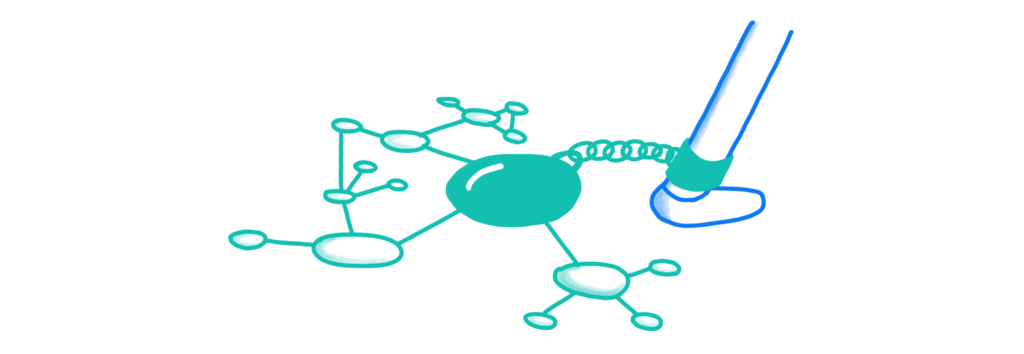
The flip side of self-management: between enthusiasm and dizziness

Self-management is easy to love on paper. More autonomy, less hierarchical weight, more initiative, decisions made closer to the action: just about everything missing from organizations that have become too slow, too vertical, or too dependent on a handful of people. As long as we talk about it as a project, the promise is exciting.
Then comes the moment when autonomy stops being an idea and becomes a real responsibility.
I have often seen people who were very much in favor of more autonomy suddenly find themselves much less comfortable when a real decision fell to them. Not a trivial decision, but one with consequences, a possibility of being wrong, and behind it, that old question that resurfaces quickly: “What if I get it wrong?” As long as freedom remains abstract, it is attractive. When it involves having to decide, it carries weight.
This is probably one of the first flip sides of self-management: it gives more freedom, but it also exposes one much more directly to responsibility.
Freedom suddenly becomes a responsibility
In a classic hierarchical organization, responsibility is often distributed in a rather peculiar way. You can propose, execute, sometimes even recommend, but when a decision becomes sensitive or risky, it generally goes up the chain: to the manager, the director, the person who formally possesses the legitimacy to decide. This verticality has many disadvantages, but it also has a reassuring function: when a choice becomes uncomfortable, someone else can carry the final decision.
Self-management profoundly changes this mechanism. It seeks precisely to bring the decision closer to those who have the information, the expertise, and the responsibility for the subject. But this assumes that a person can actually say to themselves: “This decision belongs to me. I have enough information. I am going to decide.”
This transition is less natural than one might imagine, because the organization doesn’t change simply by modifying its organizational chart or distributing new roles. Reflexes remain, the fear of error too, and above all, accumulated experience stays present. In many companies, a mistake has long been something that had to be explained, defended, and sometimes paid for. You can announce all the autonomy in the world; if everyone continues to think that a bad decision will be punished, people will logically seek to protect themselves.
This is where the right to make mistakes stops being a benevolent statement and becomes a very concrete condition for autonomy. It obviously does not mean that results no longer matter, nor that all mistakes are equal. It means that a decision made in good faith, within a clear scope of responsibility and with the available information, can become a learning opportunity rather than an occasion to look for someone to blame.
Without this safety, autonomy remains largely theoretical.
When no one knows who decides, everyone decides
A second difficulty appears when autonomy is redistributed without having sufficiently clarified roles. At the beginning of a transformation, the work of describing responsibilities and authorities can easily seem excessive. Why specify so much who can decide what? We know each other, we already work together, we want to stay flexible and, above all, not recreate the bureaucracy we are trying to leave.
The problem appears at the first serious disagreement. A decision comes up, several roles are involved, and no one knows exactly who it belongs to. The most reassuring solution then consists of bringing it back to the collective: “Shall we talk about it at the next circle?”
This phrase may seem very collaborative. Sometimes it is primarily a sign that no one dares to take the responsibility to decide.
The first effect is a considerable loss of energy. A decision that one person could have made in five minutes mobilizes five or six people for half an hour. Opinions are shared, people are consulted, we try to get everyone to agree, then we sometimes schedule a second discussion because a concerned person was not present. Self-management then paradoxically becomes slower than the hierarchy it was meant to replace.
An effective self-managed organization therefore depends much less on its ability to decide everything together than on the ability of each individual to know what they can decide alone.
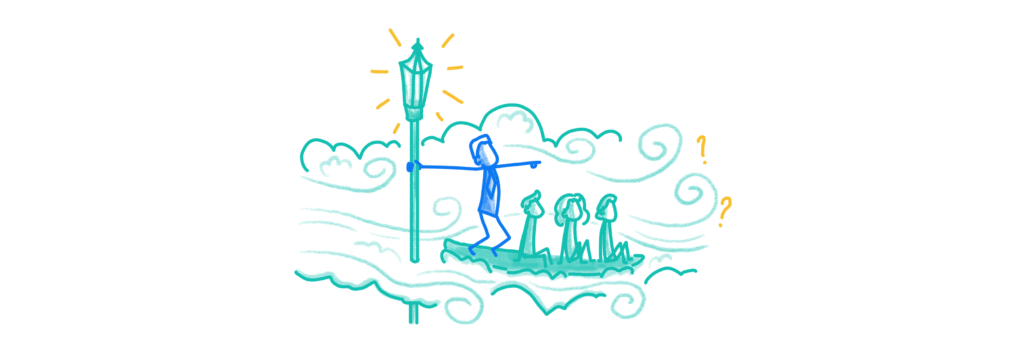
The second effect is even more revealing. The former boss is often still in the room. When, after twenty minutes of discussion, no one knows how to decide, eyes naturally end up turning toward him or her. It is not necessarily conscious, nor even desired by the former manager, but the hierarchical reflex is still there.
The official structure has changed. The behaviors, however, have sometimes simply kept the old system in memory.
We find here directly what I mentioned in Governance is boring… really?: removing a structure does not automatically create autonomy. If you don’t replace it with a sufficiently explicit framework, power doesn’t disappear; it simply becomes harder to see.
No more boss… but still a boss in the head
There is another flip side, much more intimate, that is talked about less. We readily imagine that removing hierarchical control will automatically decrease pressure. This happens, of course. But in some situations, the result can be exactly the opposite: freedom increases the mental load when the limits of that freedom are not sufficiently structured.
I encountered this phenomenon myself when I became a freelancer. From one day to the next, I no longer had a boss, no one to control my schedule, track my work, or ask me what I had produced at the end of the week. On paper, it was total freedom.
In practice, I gradually realized that I hadn’t removed my boss. I had become my own boss—and not necessarily the best one. The one who feels he could always do a little more, who wonders if the day was productive enough, who easily transforms an available hour into an extra hour of work. For years, I continued to feel a pressure that no one was imposing on me anymore, simply because I had internalized it.
This mechanism also exists in organizations. For years, employees have learned to understand the manager’s expectations, to show they were engaged, to meet the explicit or implicit criteria that determined what a “good employee” was. Removing the manager does not make these reflexes disappear. And when the new role remains vague, the pressure can even increase: what exactly is expected of me? Am I doing enough? How far does my responsibility go? Where does it stop?
This is precisely where the precision of the framework becomes liberating. The clearer the role, the less I am forced to constantly interpret what the organization might expect of me.
Autonomy is not the freedom to do whatever I want, but the ability to act without asking in order to do what is right.
But “what is right” doesn’t fall from the sky. To be able to act without asking permission, one must still understand what my role contributes to, what responsibilities belong to me, what decisions I can take alone, and where my interdependencies with others begin. In other words, freedom becomes practicable when it has contours.
This is exactly what we mean at Paradigm21 when we talk about structuring liberties.
Less management, much more leadership
The transformation of managers is probably one of the cornerstones of a successful transition to self-management. It is also one of the places where the transformation quickly becomes personal, because redistributing authority forces a revisit of part of the professional identity of those whose function until then was to decide, control, or validate.
When you explain to a manager that part of the decisions they used to make will now be handled directly by roles or teams, a perfectly legitimate question arises: “So, what am I for?” It would be easy to answer by explaining that we simply “no longer need managers.” That would be missing the point.
A self-managed organization indeed needs less management in the classic sense: less control, less validation, fewer decisions that systematically go up the chain. But it needs much more leadership. If managers have been well chosen, they often already possess some of these qualities: they know how to give meaning, perceive a difficulty, support a person, connect issues, contain a complex situation, or create trust.
These abilities do not become useless. On the contrary, they take on more importance. What changes is their purpose.
In a traditional organization, being a good leader can still consist of mobilizing people behind a direction and, in a way, creating followers. In a self-managed organization, this is no longer enough. Leadership must gradually serve to create other leaders: people capable of taking initiative, exercising authority in their field, owning their decisions, and sometimes even choosing a path different from the one their former manager would have chosen.
This directly relates to the reflection developed in Leadership without the suit: the responsibility of letting go. Letting go does not mean disappearing or becoming passive. It means continuing to fully assume one’s responsibility, but without needing to be the person through whom all responsibility passes.
What the manager did must still be done
There is a classic trap in transformations: removing a role imagining that the needs it met will disappear with it. This is rarely the case. Some functions may have been poorly concentrated, exercised too vertically, or become excessive, but that does not mean they were all useless.
Feedback is a good example. In a classic hierarchical system, it generally belongs to the manager to observe, evaluate, correct, and initiate certain improvement steps. We can discuss the quality of this loop, which is sometimes too rare, too subjective, or too focused on evaluating the person. But a feedback loop exists nonetheless.
If this centralization is removed without rebuilding something else, the collective can find itself with a lot of autonomy and almost no improvement mechanism. Yet a system that no longer receives feedback ends up repeating its habits. It can function correctly for a while, with competent and well-intentioned people, but if nothing regularly compares “how we function today” and “how we could function better tomorrow,” its learning capacity weakens.
In self-management, this function must therefore be redistributed. It appears in peer feedback, in a meeting closing round where we no longer talk about content but about how we worked together, in a retrospective where a circle observes its own functioning, or in the regular review of a role that has become unsuitable.
These practices may seem incidental when looking only at the work to be produced. They are actually what prevents the system from freezing.
Removing a role does not necessarily remove the need that the role met.
The real question is therefore not just: “Can we do without managers?” It is rather: what useful functions were until now concentrated in them, and where should they live tomorrow?
The trap of structure allergy
We then return to a paradox I already explored in the article Governance is boring… really?: many organizations approach self-management with a real allergy to anything that looks like structure, and this reaction is perfectly understandable. They are coming precisely from a world made of procedures, hierarchical levels, validations, frozen job descriptions, and a bureaucracy that has sometimes taken precedence over real work.
The desire for movement is therefore legitimate. The mistake consists in believing that movement will come mechanically from the disappearance of structure.
The absence of structure is not self-management.
It has another name: anarchy.
A second, more subtle belief consists in thinking that any formalization would prevent emergence. We shouldn’t specify too much, because things must remain mobile; writing a role or a rule would already mean carving them in stone. I often hear a variation of this idea: “Let’s keep it simple, stay agile, and we’ll adjust as we go.”
The intention is right. The reasoning less so.
To adjust something, you still have to be able to see it.
An implicit structure is no more agile than an explicit structure. It is simply harder to observe, and therefore much harder to evolve consciously. Agility does not lie in the absence of structure; it lies in the ability of that structure to move when reality changes.
An organization can have very precisely defined roles and remain extraordinarily agile if it has a simple mechanism to evolve them. Conversely, a team can have practically nothing formalized and remain for years a prisoner of habits that no one really knows how to question.
Formalism is therefore not the real problem. It becomes one when it stops serving the operation to become an end in itself.
Neither carved in stone, nor written in the sand
It would obviously be easy to fall into the opposite extreme. After discovering the virtues of clarity, an organization could seek to formalize every interaction, every responsibility, every exception, produce endless role descriptions, and gradually accumulate rules until it recreates exactly the bureaucracy it wanted to leave.
A living structure is not an exhaustive structure. It is explicit enough to allow people to orient themselves, precise enough so that authority and responsibility are not constantly referred back to the collective, and light enough to be modified when reality requires it.
The right level of structure is therefore not a formula that can be defined once and for all. It depends on the context, the maturity of the collective, the complexity of the work, and it evolves with them. Too little structure creates blurriness and shifts coordination onto individuals. Too much structure rigidifies, disempowers, and ends up killing precisely the initiative that we were seeking to release.
Self-management is therefore not a state in which an organization arrives one day. It is a capacity it develops: that of consciously evolving the way it distributes authority, organizes work, learns from its experience, and adapts to what changes around it.
This also explains much of the dizziness encountered along the way. We gradually remove certain known landmarks without immediately having all the new ones. We discover that more freedom implies more responsibility, that the absence of a boss does not necessarily remove pressure, that deciding together is not always more mature than deciding alone, and that managers do not simply disappear: their leadership must change in nature.
And above all, we discover that a freer organization is not a less structured organization.
It is structured differently.
This is perhaps the most interesting flip side of self-management. What we first took for a promise of freedom finally forces us to become much more precise about our responsibilities, more aware of our interdependencies, and more attentive to the mechanisms that allow us to learn collectively.
Dizziness is therefore not necessarily a sign that something is not working. It can be a sign that we are finally starting to encounter what the old system used to handle for us.
The question is then no longer just: are we free enough?
But rather: have we sufficiently structured our freedom to be able to truly own it?

I founded Paradigm21 in 2018 to share 3 years of experience in creating and managing a "distributed" organization. I am committed to supporting the transformation of our society and its institutions.
Specialized in the diagnosis and supporting transformation, I combine Spiral Dynamics, Integral Vision with a human and holarchic approach to organizations.






Responses