


Evolution Illustrated with Spiral Dynamics (3/4)

Spiral Dynamics is a useful tool for shedding light on the changes underway and for understanding the stages of individual, collective, and organizational transformation in an increasingly complex world. This four-part series aims to explore this lens.
The first article, titled Introduction to the Evolutionary Model of Spiral Dynamics, lays the groundwork for the levels of existence and value systems of Spiral Dynamics. The second article explores in detail The Levels of Existence in Spiral Dynamics, and in this article, we use two examples (burnout and the evolution of our post-industrial society) to illustrate just how our center of gravity evolves. Finally, the last article will shed light on how earlier levels of existence can be reactivated: Spiral Dynamics in the Time of Coronavirus.
Our center of gravity evolves
Each person has, at a given period in their life, a level of existence that operates as their center of gravity. If we draw an analogy with a house, the center of gravity is the floor we currently live on, and we all keep in the basement the complete collection of our earlier levels of existence . Their batteries are always full, and we can at any time shift down a gear and adopt an earlier level (way of thinking) when the life conditions call for it. In the same way, we all have future levels stored in the attic, and we’re capable of evolving toward these new levels when there’s a lack of congruence between our current way of thinking and an evolution of life conditions.
As a reminder, Spiral Dynamics codifies the process of evolution and the stages of transition from one level of existence to another using points named α, β, γ, and δ, which can be assessed to diagnose and support a transformation.
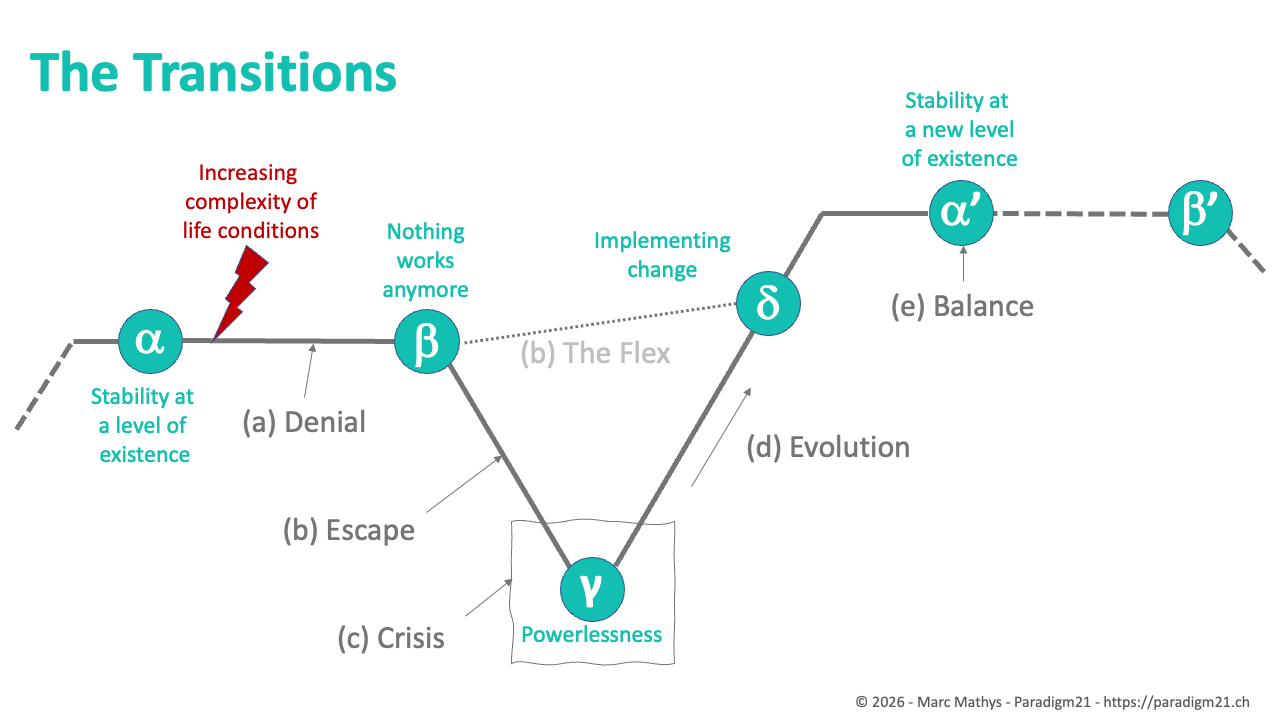
Instead of using score-based diagnostics (which are more useful in a specific transition phase), we elaborate here on five phases, named (a) through (e), as they can be experienced during a transformation.
NAVIGATING COMPLEXITY, VALUES AND CHANGE
Why do we resist change? How can we understand conflicting values and discover new possibilities for growth and transformation?Discover the Level 1 Masterclass in Spiral Dynamics, a powerful framework to:
- Understand yourself – Recognise the value systems shaping your beliefs, reactions and choices.
- Make sense of others – Explore conflicting perspectives and what drives resistance to change.
- Navigate complexity – Discover new possibilities for personal, organisational and societal transformation.

Burnout – an example of individual evolution
As dramatic as it is, burnout is the ultimate symptom of the Orange value system’s pursuit of success. It’s no surprise that individuals reach a breaking point in a professional world where being overloaded is seen as a badge of honor, caught in an endless race for profit and infinite growth. Since this is a sensitive topic for those who have experienced it, readers are invited to approach the description of the stages below with some distance. They don’t necessarily correspond to every case of burnout and don’t constitute a theory or explanation of the phenomenon. The sole purpose is to illustrate what “can happen” when applying the Spiral Dynamics evolution process:
- Denial – There’s a good chance that a person who has reached this point of no return previously felt tension around external demands or pressure they placed on themselves. The small adjustments possible in these moments include taking time off, going on vacation, or adjusting their job scope. These adjustments may have temporarily relieved the pressure.
- Escape – After taking vacation or making other adjustments, there’s certainly a phase of escape as tensions resurface. We tell ourselves, “it’s only temporary, things will get better once this or that deadline has passed.”
- Crisis – When it becomes impossible to escape the tension because it keeps growing, the reflex is to look for solutions in earlier levels of existence.
- The order of blue offers a normative outlook and a posture of submission rooted in the postwar economic boom (1950 to 1980). Our Blue mindset whispers to us: “It’s important to have a good job to secure your retirement; it’s not reasonable to consider anything else. Be grateful you even have a job, when so many people don’t.“The power of red offers a posture of domination; our inner red voice whispers to us: “Come on, show them what you’re made of! This is no time to give up, you’re worth more than that… you’re not weak“.
- Evolution – In the case of burnout, some people manage to step back before reaching the breaking point, let go of everything, and rebuild themselves in a different environment. Unfortunately for others, this realization comes only after reaching the breaking point, requiring rest and a rebuilding process that can take months or even years. During this rebuilding phase, these people develop a need to function in a different professional environment, far from competitiveness and constant pressure. They aspire to work in a collaborative environment, with firmly rooted values and a strong collective culture. They seek to join a team that offers them a strong sense of security and belonging. For them, it’s the emergence of a new way of thinking about the world of work; they sometimes consider a career change or develop new practices to sustainably integrate this new paradigm.
- Balance – Once this transformation is integrated, these people find harmony again in a new professional context. They have then evolved toward the green level of existence and feel once again in congruence with their environment.
The evolution of our post-industrial society – an example of collective evolution
At the collective level, we go through similar stages as our society becomes more complex. To identify the arrival of a point of evolution, rupture, or paradigm shift, we need to detect whether yesterday’s solutions to problems are becoming today’s sources of problems.
One example to illustrate this is the economic situation the world found itself in at the end of the Second World War. Europe’s infrastructure and economy had been destroyed. The United States seized the opportunity to rebuild Europe with the Marshall Plan, investing billions of dollars. The goal was to produce as many goods as possible in order to revive the European economy and create a thriving market for American exports. The plan worked: the rubble was cleared, infrastructure was rebuilt, factories were repurposed, and Europe began to produce, produce, and produce some more. All of this created millions of jobs, lifted people out of poverty, and gradually enabled the emergence of a middle class that began to have the means to consume more. By increasing demand for consumer goods, this allowed for even greater production, enriched companies, raised wages, and employed even more workers. A virtuous circle took hold, and the solution responded perfectly to the problems we faced at the end of the war.
Today, it seems obvious that the capitalist system born from this virtuous circle is the source of our most pressing challenges: global warming, soil, air, and water pollution, the depletion of natural resources, excessive use of fossil fuels, the widening gap between rich and poor, the concentration of most of the world’s wealth in a fraction of a percent of the population, and so on. It doesn’t seem like an exaggeration to say that yesterday’s solution has become (at least partially) today’s source of problems.
The evolutionary journey is of course not yet complete, but we can already identify the characteristics of certain stages:
- Denial – We’ve known since the 1980s that pollution and the growing use of non-renewable energy are problems. We’ve removed CFCs from aerosols, invented solar panels and wind turbines, introduced widespread recycling (in wealthy countries), reduced our cars’ fuel consumption, and even invented the electric car. As important as these breakthroughs are, they’re only minor adjustments which, even combined, stand no chance of tipping the system and reversing the trend.
- Escape – After giving ourselves a clear conscience by recycling our waste, we’ve continued to consume relentlessly, taking low-cost flights for the slightest reason. We’ve even arrived at a kind of resignation: “as long as the whole world isn’t doing it, there’s no point in reducing my consumption or changing my habits.” Tension is rising, catastrophic forecasts about the effects of global warming are multiplying, students have mobilized for months, Greta has toured the world explaining to anyone who will listen that we need to act now. In the midst of this turmoil, the only thing we seem capable of doing (apart from slightly reducing our personal carbon footprint) is complaining about an economic system that puts financial interests ahead of the interests of society and our planet.
- Crisis –When it becomes impossible to escape the tension because it keeps growing, the reflex is to look for solutions in earlier levels of existence.
- Blue proposes elevating the State to the rank of police officer and regulator of the economy, at times banning the production, sale, or consumption of certain products. Historically, left-wing environmentalist doctrine advocated, for example, banning the sale of SUVs and introducing all sorts of taxes to push the economy to take responsibility. Although technically feasible and potentially effective, these initiatives have all run up against cautious political circles closely tied to economic (orange) interests that prefer the status quo.
- The energy of red is embodied by populist leaders elected on slogans like “Make America Great Again” and “Brexit”: let’s expel foreigners, withdraw from our international commitments, and leave the European Union, or, closer to home, ban the construction of minarets. It’s the return of fascism in many European countries, the rise of nationalism and the far right, and a retreat into oneself by placing the blame for all our problems on a minority. This is the same phenomenon that allowed the rise of antisemitism in the early 20th century and, today, it’s directed against foreigners, Muslims, or migrants.
- Evolution –the paths forward aren’t yet clear. If we go by the evolution of Spiral Dynamics, the level that emerges after orange is green, and it’s on the side of the collective. Will the 2020 health crisis allow for the emergence of a sense of belonging to humanity as a whole and a surge of solidarity that would encourage us to take charge of our collective destiny over individual interests?
- Balance – The study of Spiral Dynamics allows us to say that there will be a new balance following this evolution, or the chaos needed to bring it about. We simply aren’t yet able to make out its shape. This balance will allow us to live in congruence with our environment… until the next changing life conditions.
The continuation of this series can be found in the fourth article, titled Spiral Dynamics in the Time of Coronavirus.
NAVIGATING COMPLEXITY, VALUES AND CHANGE
Why do we resist change? How can we understand conflicting values and discover new possibilities for growth and transformation?Discover the Level 1 Masterclass in Spiral Dynamics, a powerful framework to:
- Understand yourself – Recognise the value systems shaping your beliefs, reactions and choices.
- Make sense of others – Explore conflicting perspectives and what drives resistance to change.
- Navigate complexity – Discover new possibilities for personal, organisational and societal transformation.
Resources on Spiral Dynamics
- Spiral Dynamics Integral (audiobook) written and read by Dr. Don Beck
- Spiral Dynamics in Action: Humanity’s Master Code by Dr. Don Beck, Teddy Hebo Larsen, Sergey Solonin, Dr. Rica Viljoen, Thomas Q. Johns
- Spiral Dynamics – Mastering Values, Leadership and Change by Fabien Chabreuil and Patricia Chabreuil
- ValueMatch offers a free Spiral Dynamics knowledge test, as well as a values report and a personal change report (paid)

I founded Paradigm21 in 2018 to share 3 years of experience in creating and managing a "distributed" organization. I am committed to supporting the transformation of our society and its institutions.
Specialized in the diagnosis and supporting transformation, I combine Spiral Dynamics, Integral Vision with a human and holarchic approach to organizations.






Responses