
Spiral Dynamics in the Time of Coronavirus (4/4)

Spiral Dynamics is a useful tool for shedding light on the changes underway and for understanding the stages of individual, collective, and organizational transformation in an increasingly complex world. This four-part series aims to explore this lens.
The first article, titled Introduction to the Evolutionary Model of Spiral Dynamics, lays the foundation for the levels of existence and value layers of Spiral Dynamics. The second article explores The Levels of Existence in Spiral Dynamics in detail, and the third article illustrates Evolution Illustrated with Spiral Dynamics (burnout and the evolution of our post-industrial society). Finally, in this article, we highlight how the levels of existence of Spiral Dynamics can be reactivated, illustrating this with examples from the recent Coronavirus health crisis.
Reactivating Earlier Levels of Existence
The principles of evolution in Spiral Dynamics tell us that when we reach a new level of existence, it does not replace the previous level; the impact of the latter fades without ever disappearing. This means that a previous level can be reactivated in an instant if the life conditions demand it. For example, in a crisis situation where our survival is at stake, we automatically reactivate our survival level (Beige). Be careful not to see this as a phenomenon of regression; it is an extraordinary capacity for adaptation. Depending on the context and the situation we face, we are able to navigate through the levels of existence that these deep layers of values represent.
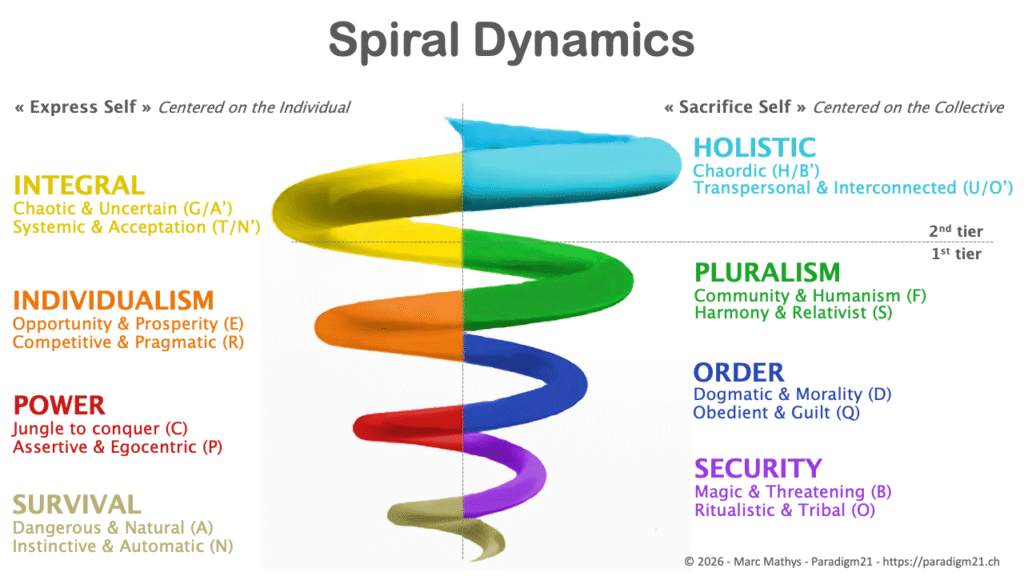
The most current example to illustrate this point is the Coronavirus pandemic, which offers us a journey through all levels of Spiral Dynamics. Let us instead develop a capacity to observe the benefits of each level while remaining critical of the unhealthy excesses of each:
- Survival (Beige) is automatic and instinctive in nature; our reptilian brain and midbrain more or less take control of our actions. We are the product of natural genetic selection over thousands of generations based primarily on our ability to survive. This ability to take action in an emergency is in our genes and is an absolutely healthy reflex.
When a dangerous virus spreads across the planet, we observe the limits of the Beige level, where unhealthy behaviors can translate into a rush for pasta or toilet paper in stores, even if it means fighting with our fellow humans for a few extra rolls. This behavior can be explained thanks to Spiral Dynamics, which allows us to understand that it is an automatic regression to the survival system when we perceive an existential danger. There is no longer any room for rational reasoning that would emanate from the most recent area of the brain in our evolution (the neocortex); this capacity is totally bypassed by the survival instinct. Unlike migrant populations who may find themselves in a survival mode for many months or even years, it is reasonable to imagine that this state is only temporary and that once the stock of ingredients perceived as essential to survival is secured, the dominance of the reptilian brain will give way to something else.
Almost paradoxically, staying activated in “survival” mode over a prolonged period probably impairs the chances of survival. The people who survived Auschwitz were those who kept hope that all this would end and who still saw meaning in their lives. Those who saw only immediate survival did not hold out. This example illustrates that the ability to extract oneself from Beige functioning (despite the survival context) and reconnect with the meaning of one’s life allowed them to find strengths that others did not.
NAVIGATING COMPLEXITY, VALUES AND CHANGE
Why do we resist change? How can we understand conflicting values and discover new possibilities for growth and transformation?Discover the Level 1 Masterclass in Spiral Dynamics, a powerful framework to:
- Understand yourself – Recognise the value systems shaping your beliefs, reactions and choices.
- Make sense of others – Explore conflicting perspectives and what drives resistance to change.
- Navigate complexity – Discover new possibilities for personal, organisational and societal transformation.

- Security (Purple) through the group allows us to calm our survival instinct and find comfort in the collective, the couple, the family, or a community. In this very healthy stage, we develop or particularly care for our social bonds and rely on cooperation. We set aside our personal desires and willingly provide help to the most fragile members of our circle.
In a pandemic context, we look after our elders and vulnerable people in our close circle. This level of existence brings comfort through cocooning, for example by gathering as a family. Faced with an external threat, some do not hesitate to declare themselves in voluntary lockdown. It is also in Purple that spiritual consciousness develops with a strong “magical, even shamanic” component. This consciousness can generate the belief that this epidemic is the Earth’s way of sending us a message that it is time to reconnect with it and take care of nature and life. This belief becomes unhealthy when it leaves us totally powerless in the face of the will of the Earth or another mystical entity. The only thing we can then do is find comfort and security in the bonds that unite us to our family or community.
- Power (Red) and the the individual’s capacity to assert themselves are a useful mechanism for confronting new dangers. It is in this level that assertiveness and determination emerge. This behavior is considered healthy, even if it sometimes expresses itself to the detriment of Purple’s solidarity; it is the force necessary to overcome the feeling of helplessness of the previous level.
Confronted with a global health crisis, it is natural for a desire to put one’s foot down and take action to emerge. Red can quickly become unhealthy. Some political leaders who usually operate in the Red paradigm have made public statements that betray the limits of their functioning. Let’s cite as an example the slowness of the British Prime Minister and the US President to take the threat seriously, convinced that it was enough to ignore the danger and distract the public. In its most extreme version, we can cite the Brazilian President who is in total denial, and his ignorance risks endangering the entire country. Closer to citizens, the healthy version of Red expresses itself by preparing for a system collapse and making reserves (beyond what is vital). In the event of a collapse, indeed, it is the strongest who will survive. Unhealthy Red expression is recognizable in those who speak as experts in epidemiology or immunology when they have no scientific knowledge of these subjects. Based on this so-called expertise, criticisms of the government then rain down—sometimes for doing too much, sometimes not enough—along with the wildest conspiracy theories. The most serious symptom of Red energy in this period of lockdown is the upsurge in domestic violence.
- Order (Blue) dictated by a recognized authority makes it possible to establish calm and channel the excesses and chaos emerging from a multitude of disjointed individual initiatives. This unifying force is healthy and allows for the control of individual impulses, learning to give up our comfort, and respecting the rules because, if we comply with recommendations and laws, then we will be rewarded and we will all benefit. Just as Purple opened the dimension of security through the collective, Blue allows for the pacification of power relations between individuals and the development of the collective dimension in the name of a higher authority or order.
This is exactly the level at which governments act with their interventions and measures to close schools, restaurants, and businesses, with the prohibition of gatherings and the lockdown of the population. When individuals or businesses do not respect the instructions, it is the police who intervene to enforce order. China and other Asian countries have used mobile phone geolocation information to monitor that individuals who have been in contact with a contaminated person stay at home. Israel is in turn using this technology, and Switzerland is talking about notifying law enforcement during gatherings in public spaces. The watchword is the same everywhere: “it is important that we all respect the rules; if everyone stays home, then we will get through this and the health system will not collapse.” The subsequent reward acts as a carrot, and morality dictates that any inadequate behavior be judged, denounced, or fined. Where Blue allows for the establishment of order to control the situation incredibly effectively, the unhealthy part lies in the unforgivable sense of guilt in which everyone finds themselves if they do not respect the rules. The drift of this system comes with the emergence of morality and normative judgment between citizens. It is not uncommon to hear strangers call out an elderly person in the street or in nature, shouting the injunction: “it’s for you that we’re stopping our entire economy, so stay home!”
- Individualism (Orange) being the dominant paradigm of Western society, it is therefore not surprising to see it come galloping back after exploring the previous levels. This level allows us to regain the individual freedom that is oppressed by Blue by taking personal initiatives. Orange, in its healthy version, invites us to rejoice in the individual freedom we enjoy while teleworking; it is finally possible to escape the excessive presenteeism (a relic inherited from Blue) that still predominated in many corporate cultures. This freedom can even give rise to new ambitions. Some will start writing that book they have always dreamed of writing (or this series of articles on Spiral Dynamics), start that entrepreneurial project that has been on their mind for a while, or set ambitious challenges to lose weight or build their abs. Others take this opportunity to reinvent their profession, whether through teleworking, selling products online, experimenting with telemedicine, or creating online training. In our personal lives, we showcase ourselves on social media and share our genius ideas for keeping our children busy or redecorating the house; we publish photos of our virtual happy hours as if we were the first to have invented the concept.
If the energy we develop in the Orange level can give us the impression of functioning at full capacity, or even give us wings, we can quickly (re)turn to the limits of the model. Like the capitalist who focuses on growth despite the impact on natural resources, Orange energy during a lockdown period focuses on success and productivity despite the limits of our human resources. A great hypocrisy that the health crisis cruelly highlights is the growth of inequality experienced by parents and, even more so, mothers. For a single-parent family or for people (most often women) whose partner is 100% occupied outside, there is no childcare solution. The order to work at home while looking after one or more children is paradoxical. How can one look after children, homeschool them, avoid any risk of contamination, preserve good intra-family relationships, take care of the housework, do the shopping alone or online, and ensure healthy eating while having adequate leisure and rest time?
From an economic point of view, this reveals a paradox that was previously invisible: parenting and household tasks are not remunerated because they do not exist in the value chain that produces an economic profit. Today, we discover that if these tasks are not managed, it is difficult, if not impossible, to have an economic activity. Looking after one or more children and a household is almost a full-time job… and unpaid. This observation has the merit of challenging us to find how to value it in the future.
The Orange mode of operation certainly generates performance, but it puts individuals under pressure to achieve it. In this period of crisis, we are generating the same ills that we observed in the economic system before the crisis: inequality, stress, and anxiety. Experts are already talking about the first cases of emotional burnout observed in people juggling all the mental loads (professional, parental, family, relational, household) without any external help.
- Pluralism (Green) comes to fill the feeling of emptiness and loneliness that the race for performance and success in Orange can generate. The quest for meaning becomes the watchword; we elevate well-being and inner peace to the rank of personal discipline and seek connections with others who are on the same path. Where Orange in crisis exacerbates inequalities, Green reintroduces equality between men and women. Since Green emerges in reaction to the excesses of the dominant Orange world, it feels marginalized and only finds its sense of normalcy through belonging to a collective that shares its values. A company with a Green component will have a strong cultural component, a less hierarchical organization, and a sense of equivalence among all colleagues. The bursts of solidarity we observe in this crisis are the very symbol of Green. The examples are endless: home delivery, help with shopping for people at risk, volunteering, free IT services, free psychological consultations or listening spaces, applauding healthcare staff at 9 PM, or neighborhood singing, each on their balcony.
The unhealthy side of Green comes from its strong opposition to previous levels. Where Blue imposes order and creates a morality of “good” and “bad,” Green develops a new form of dichotomy in which it places on one side the nice ones—rather awakened, conscious, in touch with nature, and fans of personal development—and on the other side, the mean unconscious capitalists and politicians who only think about power and lining their pockets while smoking cigars and polluting the planet. This simplistic and reductive vision of the economy and the current system prevents Green from proposing credible solutions or alternatives, or even from speaking the language of the Orange establishment.
In the middle of a pandemic, this translates into a kind of “Schadenfreude” (rejoicing in the misfortune of others) seeing the economy collapse. In a somewhat caricatured way, the conscious Green person will not fail to remind us that they had been saying for a long time that it couldn’t go on like this and that this pandemic is a necessary evil so that we can finally deal with the “real problem.” While they may stand out for their ability to master non-violent communication, they are, on the other hand, limited by their allergy to the Orange world and unable to find any form of compromise in a conversation aimed at reconciling the existing with the new. This intransigence and “all-or-nothing” attitude are the two elements of their Achilles’ heel.
- The Integral level (Yellow) is the first level of existence of the second tier. The first six levels make up the first tier, where each new level emerges in opposition to the previous one. The second tier breaks with this pattern of evolution. The Yellow level is therefore integrative in nature and recognizes, includes, and transcends all underlying value systems. It is the first level in which we can function without anxiety in a complex, often chaotic system marked by change and uncertainty.
Although Yellow is again in the self-expression, this is never done to the detriment of others or the environment. It is no longer social pressure, as in the Orange level, that makes us take action, but an intrinsic force and motivation. This ability to integrate all previous levels and to be at peace in a chaotic situation while having access to a capacity for action is an advantage in a situation such as the Coronavirus crisis. With this way of seeing the world, it becomes possible to start thinking about “who we want to be” in this crisis and to outline paths for individual and collective evolution.
While the Blue and Orange levels are experiencing a collective mourning for the loss of normalcy and unprecedented economic uncertainty, Green secretly hopes for a collapse of the system without being able to articulate the slightest path for a system that could replace the current one. As for Yellow, it is already in the serenity that is the ultimate stage of the grief curve (source: Elisabeth Kübler-Ross). This is the place from which the future is created from everything that is already present. This article having been written in what seems for the moment to be the “middle” of the crisis, it is still too early to observe the actions emanating from Yellow. It is likely that these will emerge closer to the end of the crisis, during reconstruction.
- The Holistic level (Turquoise) is not yet perceptible to most people. To conceive of it, it is useful to remember that it is the second level of the second tier. Just as Yellow shows similarities with Beige in the context of our species’ survival in the face of health or climate threats, Turquoise will have similarities with Purple. Where Purple finds spiritual meaning in the manifestations of nature, Turquoise perceives all forms of life as part of the WHOLE, similar to the teaching of non-duality in Zen, Buddhism, Taoism, Hinduism, or Sufism. Although conceptually imaginable, experiencing life on this deep value base is accessible to only a few individuals.
To capture the weak signals of the emergence of this level of existence, one can look to energy healing practices that call upon a global energy to which we are all connected. Listening to practitioners in this field, the shared observation is that we are witnessing a rise in the planet’s vibrational rate. It is through this energy that we develop a greater collective consciousness on the scale of humanity. Solidarity on a global scale is the raison d’être of Turquoise, and spirituality then becomes an essential element of humanity, complementing science in the explanation of life.
The way the levels of existence of Spiral Dynamics are illustrated here could lead one to believe that it is a succession of states with the achievement of an equilibrium at each stage. This would be a simplistic and reductive view of Spiral Dynamics. By adopting the Yellow vision of the second tier, it becomes obvious that each of the stages of the spiral is necessary and fulfills a function in a given context.
The accumulation of levels of existence
Without going into detail, Spiral Dynamics also allows for a very approximate mapping of the evolution of Western civilization. In this context, the transition from one level to another took several centuries or even a few millennia.
Note that the assimilation between a behavior and a level of existence in the following example is simplistic and serves only to illustrate the fact that previous levels are easily reactivatable and that higher levels contain and transcend previous levels. In reality, it is not a behavior that indicates a level of existence, but WHY that behavior occurred. In a phase of internalizing Spiral Dynamics, it is normal to take some shortcuts, but these become the first traps when using Spiral Dynamics to support change.
What makes a crisis situation like that of 2020 complex and unique is that it is possible to accumulate and alternate between all levels of existence in a short period. It would not be unthinkable to accumulate all these behaviors in a single day:
- filling your cupboards with non-perishable food (Beige) — not forgetting the toilet paper;
- seeking security in cocooning (Purple) to forget our helplessness during lockdown;
- criticizing the authorities and proposing our own solutions for managing the health crisis (Red) during the weekend virtual happy hour with the family;
- submitting to lockdown and severely judging all those who do not strictly follow the authorities’ instructions (Blue);
- taking photos of our children homeschooling and sharing them with our teleworking colleagues during our Zoom session in the spirit of “look how I’m totally nailing the juggling of roles” while cultivating a secret hope for a promotion for having “managed this crisis well” (Orange);
- telling anyone who will listen that this couldn’t go on and that there’s nothing like a good pandemic for us to seriously tackle the problem of global warming (Green);
- seeing the situation as it is, being impressed by its complexity, and finding a moment of respite from all our other behaviors, simply in acceptance and in the present moment (Yellow).
The greatest cognitive difficulty we encounter in this situation is the multiplication of levels of existence, combined with the inability to create connections between these levels. This can give us the impression of a loss of bearings, a lack of consistency between our ways of thinking and our actions. This is painful, tiring, and increases our propensity for self-criticism and judgment.
The framework offered by Spiral Dynamics makes it possible to distinguish each of these levels in our daily lives, to accept them without judgment, and to take a broader, integrative perspective (Yellow) toward everything that happens to us. From there, it becomes possible to extract oneself from the traps that each level sets for us. We will therefore be able to sleep well without having a cellar full of toilet paper; we will no longer sink into the helplessness that Purple can create if we think that a mystical force (like Mother Earth) is at the source of this crisis; we will learn to interact with others without pretending to be an expert on the situation and knowing how “we should have done it”; we will move away from morality and the judgment of our fellow citizens; we will see other paths than individual success for our fulfillment; we will stop seeing this crisis as a miracle solution to all the ills of our society and see that the collapse of the system is not the only way to transform it.
We will thus be free, serene, and able to build our future as individuals, and to contribute to the evolution of our society, our economy, and perhaps our civilization.
The use of the future tense in this last sentence points to the actionable lever of Spiral Dynamics. “Everything would be different if we acted differently. And we would act differently if we were different, but since we are as we are, nothing is different.” How can we escape the limitations expressed by this parable?
Spiral Dynamics is certainly only a model, a reading grid. Although it is a unique model due to its openness, its scalability, and its integrative approach, the true power of Spiral Dynamics lies in the change of perspective it proposes.
By changing my perspective on the world, it is the world that changes for me. By changing my perspective on others, it is others who change for me. By changing my perspective on myself, it is who I am that changes for me. And when who I am, others,andthe world change, my actions are the reflection of a new reality.
NAVIGATING COMPLEXITY, VALUES AND CHANGE
Why do we resist change? How can we understand conflicting values and discover new possibilities for growth and transformation?Discover the Level 1 Masterclass in Spiral Dynamics, a powerful framework to:
- Understand yourself – Recognise the value systems shaping your beliefs, reactions and choices.
- Make sense of others – Explore conflicting perspectives and what drives resistance to change.
- Navigate complexity – Discover new possibilities for personal, organisational and societal transformation.
Resources on Spiral Dynamics
- Spiral Dynamics Integral (audiobook) written and read by Dr. Don Beck
- Spiral Dynamics in Action: Humanity’s Master Code by Dr. Don Beck, Teddy Hebo Larsen, Sergey Solonin, Dr. Rica Viljoen, Thomas Q. Johns
- Spiral Dynamics – Mastering Values, Leadership and Change by Fabien Chabreuil and Patricia Chabreuil
- ValueMatch offers a free Spiral Dynamics knowledge test, as well as a values report and a personal change report (paid)

I founded Paradigm21 in 2018 to share 3 years of experience in creating and managing a "distributed" organization. I am committed to supporting the transformation of our society and its institutions.
Specialized in the diagnosis and supporting transformation, I combine Spiral Dynamics, Integral Vision with a human and holarchic approach to organizations.




Responses