


Introduction to the Evolutionary Model of Spiral Dynamics (1/4)

Whether we look at the acceleration of technological cycles, the rise of artificial intelligence, global warming, the COVID health crisis, or the excesses of overconsumption, financialization, and capitalism, it is becoming difficult not to perceive that our society, our economy, and perhaps our civilization are embarking on a phase of profound evolution.
Spiral Dynamics is a useful tool for shedding light on the changes taking place and for understanding the stages of individual, collective, and organizational transformation in an increasingly complex world.
Our choices and decisions, whether individual and/or collective, are determined by our worldview, our value system, our character, our past experiences, our education, as well as cultural and social aspects. This is what Spiral Dynamics calls a level of existence.
Spiral Dynamics is at the heart of Paradigm21’s training and support. It makes it possible to understand change within organizations and to support the expansion of consciousness through the different layers of individual and organizational evolution.
We are convinced that Spiral Dynamics can serve as a framework in a broader context than organizational transformation. This article is an introduction to Spiral Dynamics, the different levels of existence, and the stages of evolution from one level to another. In order not to overlay too many layers, this article voluntarily leaves the organizational component aside to address it in a future article.
This series of four articles begins with this introduction to the Spiral Dynamics evolution model. The second article will explore in detail The Levels of Existence in Spiral Dynamics, and the third article illustrates Evolution Illustrated with Spiral Dynamics (burnout and the evolution of our post-industrial society). Finally, the last article will highlight how previous levels of existence can be reactivated: Spiral Dynamics in the Time of Coronavirus.
Evolution as seen by Spiral Dynamics
Based on the work of Professor Clare W. Graves, continued by Don Beck and Chris Cowan, and validated by more than 25 years of field studies, Spiral Dynamics is a model that allows us to map the evolution of humans through different levels of existence. This empirical model tells us that during each significant transformation of the life conditions we face, we must deal with new challenges and are led to function at a new level of existence.
This model does not aim to set a norm. By that, understand that it is not about climbing the ladder of levels. A state is considered “stable” or “balanced” when the way we think and act is in congruence with the life conditions (social, economic, environmental, etc.). In this case, our neurological capacities are in line with our life conditions, allowing us to develop behaviors that are consistent with our environment and our capacities.
This state of balance coincides with self-regulation (called “homeostasis” in biology and systems theory), which tends to maintain a state considered beneficial for the system. This state of balance is observable at every level of a living system (from the biological level of the cell to the scale of society) by its propensity to minimize chaos (also called “entropy” in thermodynamics).
The propensity to minimize chaos based on the study of biobehavior and neuroscience: The approach (known as “Markov blankets” [1]) is based on the study of biological systems across spatial and temporal scales, observing each level (cell, organ, living being, etc.) independently as well as in connection with the global living system.
The free energy principle (FEP) is a recognized model in neuroscience as a unified theory of the brain and biobehavior. The propensity of a system to self-organize in order to minimize chaos at the biological level based on the Markov approach can be applied to Homo sapiens and serve as a heuristic research guide for biological, cognitive, and social sciences [2].
The notion of a balance point at a level of existence in Spiral Dynamics is corroborated by systems evolution theories, notably Karl Friston’s free energy principle (mentioned above), which today serves as a reference predictive model for artificial intelligence [3].
When our way of seeing the world and acting match our environment, we are in a balanced state. Tensions appear when we notice a significant gap between what we expected and what we perceive with our sensory system. These tensions can become the source of a questioning of our way of thinking or our behaviors. When we face a complexification of life conditions, the resulting tensions then create an imbalance between who we are (our way of thinking and acting) and our environment (our life conditions). The complexification of life conditions therefore serves as a catalyst for the mechanism of evolution.
What happens when life conditions evolve?
We sometimes face a disruption in our professional environment, a change related to a relationship, or a change in the world in which we live. Whether due to the evolution of a relationship, a company takeover, climate change, or the arrival of a pandemic, we begin to perceive our world, our environment, or our life with a new perspective. We speak of the evolution or complexification of our life conditions.
When the world around us evolves and becomes more complex, we become aware that our habits and behaviors (individual or collective) are no longer appropriate, and we are faced with the need to evolve. This follows a very specific dynamic that is found in individuals as well as in organizations and society.
Spiral Dynamics codifies the process of evolution and the stages of transition from one level of existence to another using points named α, β, γ, and δ, which can be evaluated to diagnose and support a transformation.
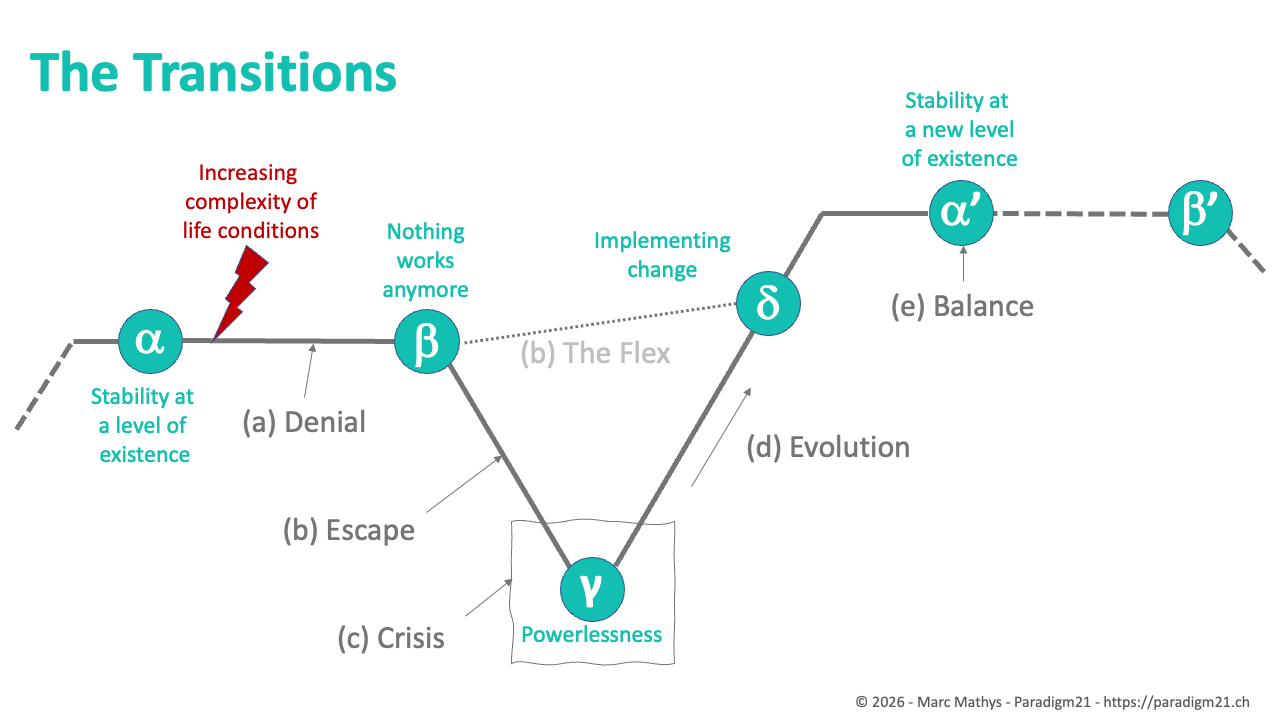
Instead of using score-based diagnostics (which are more useful in a specific transition phase), this article focuses on five phases named (a) to (e) as they can be experienced in a transformation:
- Denial – We feel a tension and we try to make small adjustments to return to a state of balance (within the same level of existence)
- Escape – If small adjustments do not resolve the tension, it suggests that larger changes are at play. We generally tend to escape such changes because they often involve having to leave a familiar environment, but also because solutions are generally not yet visible at this stage or because a new perception of the world is in development but not yet complete.
There is an alternative to escape, which is an acceptance of turbulent change and a willingness to let go of the old situation. This alternative path is called “the flex” and allows one to avoid going through a crisis to evolve. - Crisis – Escaping changes, however obvious, causes the tension to rise further. This can rise to such a point that we can no longer ignore the change and the solutions that present themselves. The first reflex is often to look for solutions in the past (in a previous level of existence ) because it seems less dangerous than going into the unknown. This may temporarily resolve the tension, allowing us to temporarily return to our initial state of balance. Over time, if the environment has become more complex, it is very likely that the tension will return in one form or another. We then find that the result of the proven solutions of the past is even worse than the initial tension.
- Evolution – The crisis leads inexorably to an awareness that opens up a new way of thinking and allows us to develop new practices, resulting in a lasting change in our life.
- Balance – As soon as the change has been integrated, we find harmony with society, our professional or family environment. This translates into greater stability in our life. We have then evolved to a new level of existence and are once again in congruence with our environment.
Three layers of values
Spiral Dynamics takes on the challenge of mapping all human values by distinguishing them into three layers. The term “level of existence” refers to the deepest layer of values. This can also be called a paradigm, because a change in these deep layers of values strongly resists superficial attempts.
1st level: surface values (conscious) – these are the values we are aware of and in which we recognize ourselves, both at the individual and collective level. To name a few examples, benevolence, success, respect, tolerance, justice, and love are first-level values.
In everyday language, when we talk about “values,” we are talking about this first level of values. These values are evolutionary in nature and relatively easily adjustable. They tend to evolve over time and with our individual and collective development. It is in the name of these surface values that we follow dress codes, participate in rituals, obey social rules, choose a profession or a company, or fight for causes or start wars.
2nd level: hidden values (in the individual unconscious) – behind the surface values, there is a layer of hidden values that contains two types:
- Masked values: these are values that also influence our way of behaving and are generally only accessible through coaching. The need to be recognized, imposter syndrome, or a mechanism of self-sabotage are a few examples. If we go a little further, we will also find values related to manipulation and Machiavellianism (in the most serious cases, these values can even be conscious). This last category is generally only adjustable through therapeutic support.
- Implicit values: these are values presumed to be known. In any family, organization, or society, there are “unspoken” values that everyone is expected to respect. These values are not easily adjustable.
3rd level: deep values (in the collective unconscious) – after discovering that a layer of hidden values exists beneath our surface values, it becomes imaginable that a third layer could exist. These “deep values” describe structures that accommodate surface and hidden values and are represented by the eight levels of existence of Spiral Dynamics identified to date. Unless one studies the spiral, these levels are observable in the collective unconscious of our civilization. For example, the fact that so many individuals are obsessed with success and achievement does not necessarily stem from an internal individual driver but from a deep value that is in the collective unconscious.
The continuation of this series can be found in the second article entitled The Levels of Existence of Spiral Dynamics.
Resources on Spiral Dynamics
- Spiral Dynamics Integral (audiobook) written and read by Dr. Don Beck
- Spiral Dynamics in Action: Humanity’s Master Code by Dr. Don Beck, Teddy Hebo Larsen, Sergey Solonin, Dr. Rica Viljoen, Thomas Q. Johns
- Spiral Dynamics – Mastering Values, Leadership and Change by Fabien Chabreuil and Patricia Chabreuil
- ValueMatch offers a free Spiral Dynamics knowledge test, as well as a values report and a personal change report (paid)
Cited sources
- The Markov blankets of life: autonomy, active inference and the free energy principle by Michael Kirchhoff, Thomas Parr, Ensor Palacios, Karl Friston and Julian Kiverstein (2018) R. Soc. Interface. 15:20170792
- Answering Schrödinger’s question: A free-energy formulation by Ramstead, Maxwell & Badcock, Paul & Friston, Karl. (2018). Physics of Life Reviews. 24.
- Free energy principle, Wikipedia

I founded Paradigm21 in 2018 to share 3 years of experience in creating and managing a "distributed" organization. I am committed to supporting the transformation of our society and its institutions.
Specialized in the diagnosis and supporting transformation, I combine Spiral Dynamics, Integral Vision with a human and holarchic approach to organizations.






Responses